
Dated January 11, 2022. Performance information has been removed from this version in accordance with the firm's policy on publicly available materials, adopted in 2026. Because the removals were made largely by cutting rather than rewriting, some passages are incomplete or end abruptly. Performance information is available to qualified investors on request — contact ir@philipequities.com.
Interpretation of Results
Performance information is available to qualified investors on request. Contact ir@philipequities.com.
Stance on Current Market Paradigm Going into 2022
Economic View and How it Influences Capital Allocation
Paul Gennari, a great guy and head of the gym at my firm, recently filled me in on a December 2021 Patriots' football game in which the Patriots' coach, upon witnessing strong winds, made the gutsy decision to de-risk and focus on running the ball. The team ran the ball on 4 of 47 non-kneel-down plays. Nine of these runs resulted in a loss of yardage, and the team only put up fourteen points; however, the Patriots beat their benchmark (the Buffalo Bills).
Today, when looking out 12-18 months, I believe the global economy may face headwinds from weak consumer demand and tightening monetary policy. We believe a focus on businesses that can resiliently generate strong cash flow relative to price may be well-positioned in such an environment.
By and large, today's perceived strong economic growth is based on effects and the result of government transfers pulling forward consumer spending. Let's face it; a sustained increase in real per capita income can result from technological discovery, the finding of new natural resources, or by increasing labor hours, but not through debt-financed government spending. This is especially true when the debt-financed spending does not generate an income stream that can repay principal and interest (e.g., stimulus checks spent on Chinese goods). In other words, because this debt will not create an income stream to repay principal and interest, this debt-fueled elevated spending will correspond with a decline in future spending, and thus is disinflationary. The Ricardian equivalence indicates that this short-lived elevated consumer spending may decline more rapidly than most expect.
The most relevant piece of literature to explain the current paradigm is French economist Frederic Bastiat's 1850 essay, translated as "That Which We See and That Which We Do Not See." In this essay, Bastiat tells a story of a shop owner's son breaking a pane of glass (analogous to the coronavirus and poor government policy initially breaking the economy). The immediate expenditure to fix the broken glass in the shop adds to GDP growth (just like the immediate fiscal response has been adding to GDP growth); however, the opportunity cost of what this money could have been invested in is not included in the GDP growth statistic. Interpreting the temporary increase in GDP growth associated with fixing the broken glass as a positive and extrapolating the growth out into the future would be insanity. Similarly, today's elevated GDP growth is not real sustainable growth, but instead a measure of demand being pulled forward to fix destruction.
Regarding the "mystery" of low labor participation, it is simply that government transfers and increased asset prices have increased wealth. As wealth rises, many individuals have chosen to spend some of this extra wealth on leisure (i.e., working fewer hours) instead of on goods and services. This decision is exacerbated by the perception of a less safe workplace due to the virus, as well as an increased need to stay home with children who cannot attend school.
An economics 101 concept is that when prices go up, demand goes down. It is well known that prices have gone up, but demand had not yet declined materially at the time of writing for the reasons mentioned, and shockingly, analysts price many stocks as if this unusual level of demand will continue. Demand cannot go up forever while real wages fall. This presents strong short opportunities.
Then, there are many well-followed extremely (emphasis on extremely) overvalued stocks. Even the holders of these assets recognize that the assets they hold are priced with no connection to intrinsic value; however, they continue to hold the assets with no reasonable explanation. As one of my favorite philosophers, Seneca, would say, "sometimes the mob is ready to fight against reason in defense of its own mistake." Historically, valuations have tended to revert toward fundamentals over time. Below is a little piece I wrote to friends who hold crypto assets (one kind of asset that falls into this category) in response to a YouTube video titled "How to Value Crypto Assets." However, the theme of this piece of writing applies to all sorts of speculative assets today, ranging from meme stocks to some art, watches, and homes.
View on Crypto & Other Speculative Assets
Don't mean to offend anyone or be a party pooper, but reflecting on all the crypto talk, and now having listened to this podcast, I feel compelled to voice caution for friends. This podcast should be titled "How to predict the prices of crypto assets" instead of "How to value crypto assets." Speculating is obviously just as legal as investing, and some have a talent for it, but the price prediction business and tools associated with it should not be confused with the distinctly
They discuss a variety of relative valuation tools. Relative valuation, or reasoning by analogy, is not first principles analysis. It only arrives at true long-term economic value if one is comparing apples to apples, and, importantly, if the analysis being compared to is sound (a lazy assumption for a professional assessor of economic value). With the exception of Ether's gas fees relative to its market cap (that's interesting, and I've wondered what the effective buyback yield is?...though today I'd guess that's largely dependent on the temporary speculative volume in Ether rather than the demand for the productive use cases of Blockchain technology being built on the platform) the absolute valuation methodologies the two posited throughout the podcast are tools they use to predict the future price of crypto assets but are useless for assessing economic value.
The two in the podcast make unsound arguments for why true economic value doesn't exist. To be clear, the discounted value of cash flows an asset will produce over its lifetime is its economic value, full stop. When it comes to assessing long-term economic value, 99% of the time (there are rare reflexive exceptions), narrative is 100% irrelevant. My all-time favorite video clip is the under-10-minute Buffett interview by Adam Smith in Buffett's prime in 1985.
In the clip, Buffett correctly states that an investor is not right because everyone agrees or disagrees with him, but instead he's right if his facts and reasoning are right (i.e., the narrative is irrelevant when it comes to valuation). This stark contrast in the importance of narrative evidences the substantial distinction between the business of price prediction and the business of valuation.
When investing in something of value, the buyers and sellers of an asset can both come out ahead because the asset may produce cash for shareholders during the duration of both respective holding periods. However, in the case of the crypto assets, with very few (if any) exceptions, all gains by sellers will be equal to the losses of buyers (and then subtract gas fees).
There's obviously nothing illegal about holding or buying these assets using various price prediction strategies to divine which crypto assets will attract greater fools, and I'm all for my friends making money in whatever way best suits their natural talents and passions; however, I don't want friends to lose touch with reality by holding an unjustified belief that the market value of these crypto assets understates their true economic value because then they may never sell. Assets go up the stairs, but down the elevator, so I'd hate to see friends holding the bag when the crowd rushes to get out through the door before it shuts.
History suggests speculative cycles eventually end, which is why we believe timing an exit is essential for speculators. History suggests that at some point market value of assets trading far above intrinsic value has tended to revert toward economic value like assets did during the Dutch Tulip Bulb Bubble of 1636, the South Sea Bubble of 1720, the Mississippi Bubble of 1720, the company formation bubble after the 1688 Glorious Revolution, the late 1920s stock price bubble (1927-1929), the surge in bank loans to Mexico and other developing countries in the 1970s, the bubble in real estate and stocks in Japan (1985-1989), the 1985-1989 bubble in real estate and stocks in Finland, Norway and Sweden, the bubble in real estate and stocks in Thailand,
Malaysia, Indonesia, and several other Asian countries (1992-1997), the surge in foreign investment in Mexico (1990-1993), the bubble in over-the-counter stocks in the United States (1995-2000), and the bubble in United States real estate (2001-2006). These are just a handful of the myriad bubbles that have occurred throughout history, and note that each bubble historically came to an end at some point. I believe this cycle is unlikely to be different..
Especially if you disagree with the above, I'd strongly recommend reading Manias, Panics and Crises by Charles Kindleberger. Also, a short article on the Carnegie Endowment for International Peace website titled "Why the Bezzle Matters to the Economy" is a useful read.
Current Investment Theses
Sallie Mae
Despite a Democrat sweep, no misperceived political risks became real. Already by far the most dominant private student loan lender (55%+ market share), Sallie Mae has gained market share for six straight quarters. CEO Jonathan Witter is extremely shareholder-oriented, as evidenced by repurchasing in the mid-30 percent range of shares over the last 18 months. He recently said, "We're absolutely committed to aggressive share repurchases, aggressive capital return, and I fundamentally believe capital allocation is the most important thing any bank CEO should be focused on." Jonathan continues to be receptive to my feedback, and after he concurred with my logical analysis of how much more stock the company could buyback based on average trading volume and the law, he proceeded to announce a share buyback in excess of expectations. Sallie Mae's origination growth has been coming in a bit less than its mid-single-digit trend due to one-off pandemic-related government stimulus programs that provided tremendous cash to schools, and the schools using this cash to support students (HEERF program), leading to less demand for private student loans.
Sallie Mae is not a perfect business. Some refinancing is inevitable, but refinancing is a low ROE business that has stayed steady because most Sallie Mae customers have small student loan balances, trust Sallie Mae's brand, and ultimately do not find the time and effort required to do a refinancing with a marginally lower interest rate to be worthwhile. Another negative aspect of the business is that student loan losses will go up when college graduate unemployment goes up; however, with roughly 90% of loans cosigned by parents, the inability to erase student loans in bankruptcy, high FICO scores, and always lower unemployment among college graduates than non-college graduates, Sallie Mae's loan losses should never reach a point that they imperil the business, and the mid double digit normalized earnings yield is highly attractive. A new negative aspect of the business is that enrollment and tuition will continue to face some pressure due to the coronavirus. However, the college experience of making one's own schedule, making mistakes when going out at night, forming friendships (and losing friendships), joining student groups, running into a classmate and subsequently bonding over a spontaneous shared meal, and ultimately finding oneself, is not replicable on Zoom University. While coronavirus and the associated fiscal largess to colleges will continue to impact Sallie Mae at the margin, the demand for American in-person college education will endure far into the future.
Sallie Mae grows faster than major US banks, has safer loans than major US banks, and in my view has the best capital allocator around today, so the stock should deserve at least the same multiple as major US banks (i.e, double the currently depressed 7x or so earnings multiple). Perhaps a big bank CEO will find the stock price absurd and buy the business; after all, Sallie Mae's relationship with young college customers could be valuable to a big bank. However, even with no multiple rerating, the shareholder will still enjoy a double-digit annual return.
Bank of Georgia
Bank of Georgia operates in a duopoly with TBC; the two banks control about 75% of banking in Georgia (& increasing), a country of fewer than 4 million people. This dominance allows the company to price loans based on a targeted ROE above 20%. The bank has a plain vanilla business model focused on NIM and fees. The bank does not engage ni risky behavior (e.g. derivative trading), has sufficient NPL coverage, has sufficient cash collection of interest, has a long operating history, has an Ivy League educated CEO, is big 4 audited (by EY's UK partners since 2012 listing), does not take currency risk on its balance sheet, and is listed in London, which unlike a GDR, comes with the same governance requirements of the other companies listed in London.
The bank generated low double-digit ROE in 2020 despite the unprecedented crisis, which would be an attractive return for major US banks in good times. This year, the bank has been generating an ROE of around 25%. Due to the competitive dynamics in Georgian banking and the Georgian economy's attributes, I believe the bank will generate a normalized 20%+ ROE with 10%+ loan growth annually for a long period of time. The CEO with whom I have spoken is shareholder-oriented and is focused on the long-term prosperity of the bank, which includes investing in technology to fortify its competitive moat. I am of the view that I do not need to go to Georgia or any physical location of any business to understand what a business is worth, but as an anecdote, my mother visited Georgia and said the people there are extremely impressed by Bank of Georgia's mobile applications.
Georgia is democratic with a strong free market attitude running through the veins of its population and its two major political parties. The people hate Russia and love the EU/USA. A North Korean invasion of South Korea is more likely than a Russian invasion of Georgia. Russia has no logical reason to invade Georgia. The people are not ethnic Russians. There are nonmaterial natural resources. There is no strategic military advantage or economic advantage to gain. The stock trades at under 5x earnings, or the very bottom of its historic multiple range, which indicates investors are either confused or do not care. I think the stock should trade at a premium to US/UK banks due to substantially stronger growth and profitability, but even without multiple expansion, and a conservative assumption on Lari currency depreciation, this stock will return 15%+ a year. And this excess return profile is achieved with low risk as evidenced by the plain vanilla bank's business performance compared to that of the major US/UK banks during crises (e.g. 2008-2009/2020).
Moreover, the CEO, Archil Gachechiladze, is shareholder-oriented and receptive to my feedback. Based on my feedback, the bank announced its first-ever intention to repurchase shares. Additionally, the bank moved its dividend payout ratio from 25-40% to 30-50%, which at 40% represents a nearly 9% 2022 dividend yield even after the substantial runup in the share price.
Imperial Brands
My favorite investments are easy and simple (i.e., one-foot hurdles). Somewhat related to this point was a fascinating Bloomberg article by John Authers on 9/17/2021, which discussed the findings of some quant research on management language during earnings calls. Since 2014, 100 company officers using the most complex language returned 9.45% vs the simplest language 15.4%. I am unaware of research related to the complexity of capital allocator investment theses, but I would guess the simpler the investment thesis, the more likely it is to outperform.
Imperial Brands is a simple thesis. The business produces a nearly 9% dividend yield with a 50% payout ratio. The business's core product, combustible tobacco, is in decline; however, due to the heavily regulated nature of the industry, which results in oligopoly, the stickiness of the product, and the loyalty of customers to brands (partially a result of the heavy regulatory environment preventing advertising), Imperial Brands can raise the price of their product faster than volumes decline. Moreover, by and large, combustible tobacco demand holds steady in all economic environments. In sum, it is straightforward that even with no multiple expansion, shareholders will receive a 17%+ total return (perhaps substantially exceeding 20% should EBIT surprise to the upside). Plus, if tobacco perception becomes more aligned with other negative health products like Coca-Cola, then perhaps there will be some multiple expansion to add to the return (but not counting on it).
One reason the stock might offer such attractive economic prospects is that public opinion is negative towards the industry. I will never base my actions on public opinion. Instead, I place tremendous value on the fiduciary duty to clients and believe that a core part of the ethical code as a fiduciary is to never allow personal views to influence the capital allocation process. My only focus is on economic considerations as I exclusively and passionately devote my professional life to maximizing long-term returns adjusted for risk of permanent loss of capital for investors who entrust me with their capital. However, many fund managers incorporate their emotionally charged personal and political views into their investment process and philosophy, which leads these managers to avoid tobacco despite its economic merits.
Others are confused by the industry. After all, investors tend to be wealthy, educated, have health insurance, and live in wealthy cities, whereas tobacco smokers tend to be the opposite. For example, 1 in 4 West Virginians smoke, but typical Wall Street folks have not been to places like West Virginia and do not hang out with the common West Virginian. These West Virginians are, by and large, not going to stop consuming combustible tobacco products tomorrow. Moreover, combustible tobacco volumes steadily decline, which, through the consistency bias, reinforces the provincial consensus view that people are going to stop smoking tomorrow.
Kenneth Dart, who, from my readings, seems to be one of the great investors of our time, and who seems to have invested most of his net worth into tobacco soon after my initial investment, supposedly said his investment was based on the idea that people will not quit smoking tomorrow. I concur with his view because the science and psychology of habit formation and breaking is clear: breaking a strongly wired habit requires rewiring one's brain, which is psychologically extremely difficult. While most developed market new tobacco consumers will undoubtedly choose vapor or heated tobacco products over combustibles, I am nearly certain that combustible tobacco will produce substantial profitability for decades.
This year I read a Hartford Funds' white paper, and was particularly fascinated with two figures shared below:
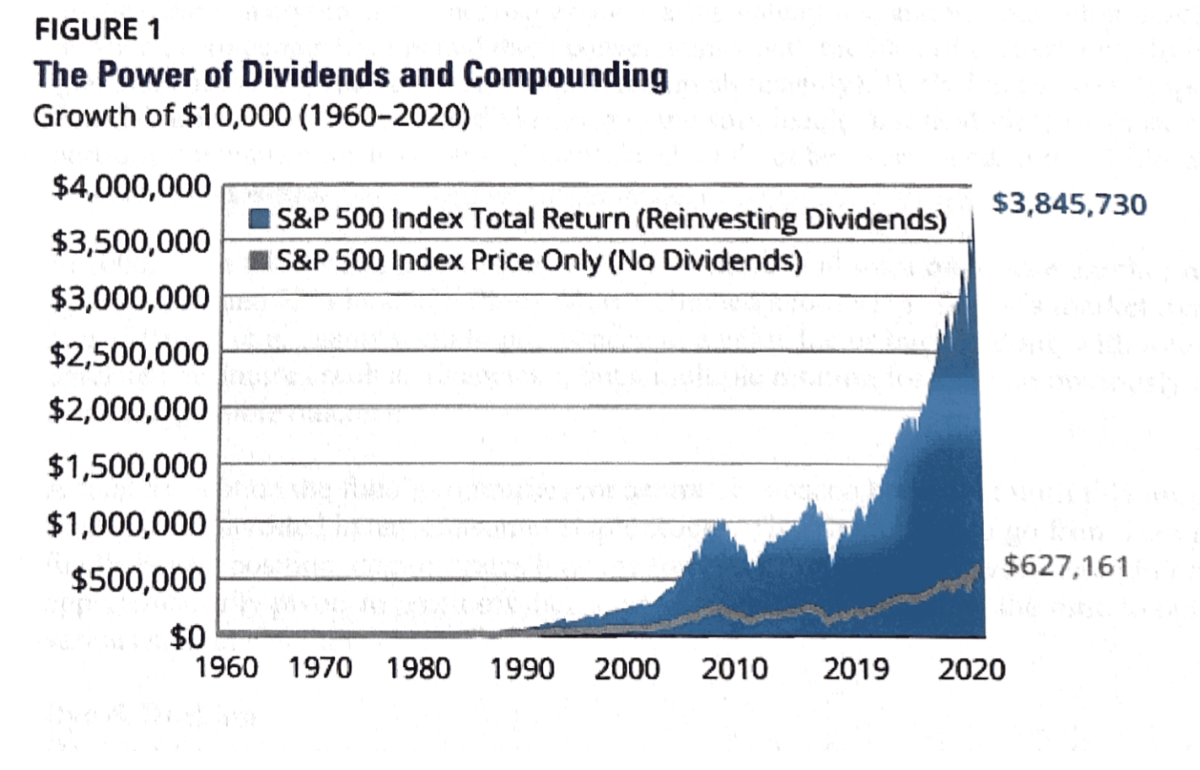
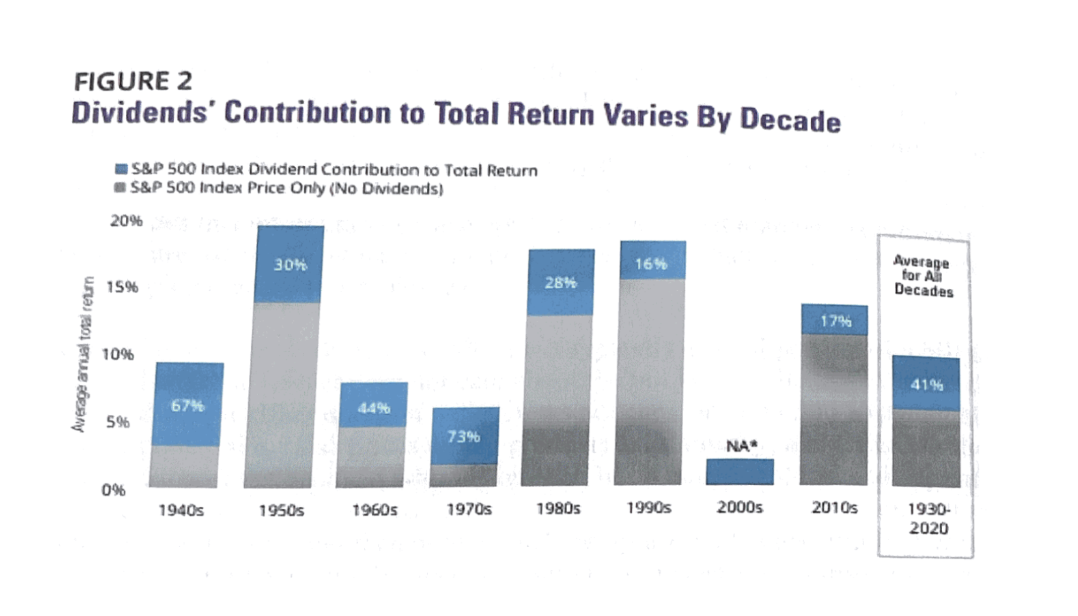
In Figure 1, note that dividends represented a material portion of shareholder returns since 1960. In Figure 2, note that while dividends contributed a relatively small amount to shareholder returns in the most recent decade, dividends contributed nearly 75% of returns in the 1970s and 100% of the returns in the 2000s. Most people I speak with believe our time is most analogous to either the 1970s (those worried about inflation) or the .com bubble (those alarmed by the bubble in crypto, art, wine, real estate, startup valuations, and various other assets); however, zero people have paired these conversations with the idea of focusing on dividends(probably because dividends have not mattered much recently). With this context, Imperial Brands' nearly 9% well-covered dividend, and the sustainable dividend yield of other core portfolio companies, such as Bank of Georgia, should not be overlooked in this 1.3% S&P 500 dividend yield world.
In 2000, when the Nasdaq lost roughly 40% of its value (and went on to lose another roughly 21% in 2001 and 32% in 2002), Philip Morris climbed about 91%. Today's market dynamics are a bit different (e.g., quants seem to put tobacco in a value factor bucket along with totally unrelated businesses such as financials), but a multiple rerating for such an obviously attractive stock is a possible outcome.
A final thought on the fund's contrarian concentrated tobacco bet is that until this investment, the fund had not invested in any consumer staple stocks. This flexibility, to go from zero to the fund's largest position, demonstrates how the fund's sector-agnostic investment philosophy opportunistically pivots to profit off inefficiencies.
Dye & Durham
DND is a Canadian company providing mission-critical software services to lawyers in Canada (40% revenue), the UK (30% revenue), and Australia (30% revenue).
DND has a suite of useful products. For example, Canada has 13 provinces, so if you are a lawyer setting up a new company and need to look up a business name or search for a lien, you would have to spend considerable time searching each province's database. Instead, DND's software quickly searches all provinces and charges a transaction fee. In the UK, information on a property can go back hundreds of years, and this information may be important (e.g., an extra tax necessary to pay to a church, or mining that had been done on the property, etc). This land information is scattered across databases, and some data can only be obtained in person. DND provides this information to lawyers in a time-efficient manner. Additionally, lawyers use DND software for coordinating documents between each other, sending documents to other parties, keeping track of timetables, etc.
The cost of using Dye & Durham's software is typically a small portion of a bill that a lawyer charges a client. The lawyer does not care about the bill because he or she is not the one paying it, and the customer either does not notice, does not care, or cannot do anything about it. Thus, there is the potential to raise prices on the products substantially, and CEO Matthew Proud, who owns about 20% of the business with his brother, has a unique boldness to capitalize on this inelastic demand. He is also an acquisition machine, continually purchasing software with this inelastic demand profile, and then crudely jacking up prices. Seems simple, but it works. Frankly, I cannot even keep up with all the details pertaining to his various acquisitions, but at a high level, the point is that he is competent and on this mission of acquiring and integrating (and by integrating, he largely means jacking up prices without material churn).
He recently made two large acquisitions. First, he purchased Telus for $500 million and then, only a few weeks later, announced the C$3.2 billion acquisition of Australian-listed Link Administration Holdings. Link Administration Holdings is a company that provides mission-critical software to more than 6,000 clients across financial services and corporate business segments (in simple terms, a sticky business conducive to aggressive price hikes). Link also owns a 43% stake in Pexa, which DND CEO Matthew Proud has wanted to own for a while. Prexa is also a sticky business conducive to aggressive price hikes. Link has roughly the same market cap as DND, so this is a big acquisition. DND is financing the deal through a C$3.25 billion senior secured debt facility, C$841 exchangeable preferred shares exchangeable at C$60 (50% premium to DND's price upon acquisition announcement), and C$109 million of common shares at C$53 per share (32% premium to DND's price upon acquisition announcement). Matthew will raise prices on the customers of these businesses, which will drive EBITDA growth. Moreover, Matthew will continue aggressively buying businesses.
This software company appears to be a non-regulated high-growth utility company. Management could double prices and see little churn. When I asked Matthew why he does not do this, he kind of let out a laugh, acknowledging the possibility, but then, in a corporate manner, simply stated that there is material room for price hikes. This is the number one reason that I am confident that the business will meet or exceed Matthew's ambitious EBITDA targets: if he is below target, he will simply raise prices and meet or exceed his target.
Matthew wanted to buy the entire Dye & Durham business at $50.50 a share this year, which the board denied. Clearly, he understands that this high-growth business (via acquisitions), which at under 10x EV/EBITDA is not only screaming cheap on the surface but is also dramatically underearning. A quant investor could not see this in the published financials, but with some abstract thinking, it is clear that this stock, while not a typical "value" stock, is extremely undervalued.
SPACs
SPACs are publicly traded, so even when I agree to be restricted on a company, I cannot share much information as the reader may not be restricted. The people leading the two SPACs the fund has investments in are working hard to complete deals. I have been quite actively helping one of the two SPACs with leads on potential targets.
After examining the probability of a SPAC liquidating based on the historical records of all SPACs, and negotiating an over 70% average discount to IPO price with two warrants per share, and with the allowance to wait to wire capital immediately prior to IPO, the conclusion was that the return profile on a relatively high quality basket of these founder shares + warrants would produce strong results ni practically al scenarios. In the reasonable worst-case scenario, the SPAC allocation will produce a double. In the base case scenario, the portfolio of SPACs should produce a 400% return. Earning well over a 400% return is certainly a material probability on the probability distribution.
I continue to believe that SPAC founder economics is highly attractive, and I look forward to investing in at least the two other (delayed) SPACs in 2022 that the fund previously committed to invest in.
Shorting
I do not like the idea of unlimited losses, so by and large do not short stocks; however, this extreme environment of fiscal stimulus induced elevated demand that is exacerbated by supplyshocks, the most extreme monetary policy in history, and animal spirits that are arguably the most extreme in any readers' lifetime, has created an environment in which short opportunities are too easy to pass up. I love easy opportunities. There are ample one-foot hurdles, and one can size positions in such a way that even if the stock goes up 100%, or even 1000%, the allocator can remain solvent and ultimately collect the free money once market values revert to intrinsic values.
Based on studying the failures and successes of short sellers, following the evolving regulatory landscape pertaining to publicly discussing shorts, and by far most importantly, deeply considering the impact to my ability to speak with and influence management of portfolio companies to create value for investors on the long side, I have decided to never publicly discuss short positions.
Mistakes of Omission & Commission
Santander Consumer
The biggest mistakes tend to be omissions, not commissions. Similarly, some big successes are omissions. For example, after much thought, I decided not to purchase Altice stock. I concluded that perceived risks seemed to be real, and the stock subsequently declined dramatically. That decision not to act contributed to performance.
A mistake of omission was not purchasing Santander Consumer. I totally understood the special limited float and aggressive buyback situation and recognized that at some point soon Santander Consumer would tender for the rest of the stock. Unfortunately, my tendency to wait for steals got the best of me in this instance. I was waiting around for the stock to get cheaper on the view that the tender would not happen imminently. Trying to time it was not in line with the fund's investment process, and I have learned from this mistake.
Momo
In last year's annual letter, in a section titled "China's Challenges," I stated: "The reason The Fund is not adding to its position in Momo is because I believe the idea of China being an investable market that does not in and of itself present a material risk of permanent loss of capital is less clear." This year, the fund exited its position in Momo's stock with a loss, due to a revised view that the fund had never held a genuine position in Momo's business.
My understanding of VIEs is that an investor holds shares in a company that is incorporated outside of China, and this company advertises to prospective shareholders the legal right to a share in profits from a company located in China; however, those legal claims on assets are legally unenforceable in China. Full stop. Therefore, even if nearly everyone on earth believes an investment in say Alibaba's stock is an investment in the assets of the Alibaba company located in China, and even if for years the stock's movement has corresponded with the Chinese-based Alibaba company's perceived business performance, the legal facts remain unchanged.
Any investor in VIEs should understand the law, and then try to falsify my analysis by referring to the law. If you can falsify it, then please contact me; if not, then you should seriously question why you own a piece of paper with no enforceable claims on assets, because at some point, the law may matter. While I recognize many intelligent investors own VIEs, based on the facts outlined, I conclude they are taking a substantial risk of unforced errors. Unless the facts change, this fund will not invest in VIEs going forward.
Five Star Senior Living
This was a bit of a tricky situation that should not be characterized as a mistake, but rather a misunderstanding.
However, this is an important case study of the situation I plan to get involved with in the future when I have full autonomy. Here is a senior living business with $100 million or so of cash, $150-$200 million of assets, and at the time of purchase, a $130 million market cap. The owned portfolio is 98%+ private pay, fully sprinklered, and has normalized 80%+ occupancy, producing $13.5 million in net operating income annually ($192 million in value at a 7% cap rate).
My idea was to build a substantial position and try to convince management to take specific actions to improve free cash flow and shareholder value. I did attempt to do this, but management was uncooperative. At this point, I intended to then control the outcome of the investment by:
- (a) trying to convince management to liquidate or sell the company and/or pay out a dividend exceeding the size of the market cap
- (b) waging a proxy contest (in this case due to their specific bylaws and concentrated ownership the goal would be to first get board approval to purchase up to 9.9% of the company, then regardless of if this request is granted, attempt to gain at least 1board seat to make other directors feel uncomfortable by charging they are not acting in the shareholders' best interests and worry them about breach of fiduciary duty lawsuits
- (c) submitting a bid for the company and trying to catalyze a competitive bidding process, and/or, the most likely scenario;
- (d) selling the position after a substantial runup in the stock price (prior to or after a, b, and c).
I spoke with a couple of lenders and had the understanding that they would support me in a bid for the company, but upon presenting the deal internally, I realized that it did not make sense for my firm to be associated with this kind of deal. Thus, I sold my position at a 10% or so loss.
Positions Sold & Reasoning
AerCap
The Ireland-based leading aircraft lessor will become the largest lessor by a more significant margin with their purchase of General Electric's GECAS (the second largest aircraft lessor). The combined business should be able to borrow money at lower rates, buy planes for lower prices, and have more leverage in negotiations with airlines, particularly considering the heavily indebted situation airlines find themselves in post-pandemic. I would have preferred AerCap repurchase shares rather than make the acquisition; however, it seems the fixed income markets prefer to lend money for AerCap to buy a competitor, subsequently sell aircraft above book value, and then use the proceeds to buy back stock, vs an outright share repurchase program. I sold the AerCap position prior to the Delta variant due to the following factors:
AerCap's excellent management team is beholden to shareholders, but shareholders are beholden to fixed income (due to most of the business being a spread business), so therefore management is beholden to fixed income. This paradigm reduces share repurchase optionality in a crisis relative to other businesses.
New variants of the virus, and evidence indicating a high likelihood of future variants, are very serious real risks that lower estimates of AerCap's future cash flows, that one can be highly certain will come to fruition; and
Government risk aversion and its slow-moving nature (combined with point number 2) indicates that mild to severe travel restrictions may continue non-transitorily
The above reasoning was prescient, considering the delta and now omicron variants have swept the globe, and governments have consequently taken action that has held back demand for travel.
Ultimately, AerCap's contracts with airlines are long-term in nature, governments have supported airlines, and AerCap's stock should continue to go up over time, but the easy money created by the mistake of investors to put AerCap in the same category as airlines has already been made. I prefer one-foot hurdles like Sallie Mae or Imperial Brands that are more insulated from macro factors.
Sandridge Energy
SandRidge Energy is an Oklahoma-based oil &gas business that had (in short) been, in the most extreme sense of the word, "egregiously" mismanaged. The market cap went from $11 billion to about a $150 million market cap at time of purchase. The company had the potential to generate about $25 million in cash flow, assuming $50 or so oil, and had a 25-40 million net cash position.
I diligenced the new management team and concluded they were prudent. For example, they sold the old corporate building (which included an apartment for the former CEO) for $35 million and moved into a bare bones warehouse building. They sold their Colorado assets to focus exclusively on their close-to-home assets in Oklahoma and Kansas. At year's end 2019, they had about 100 people in the fields and 130 corporate employees, and they brought the number of corporate employees down to 16, which saved about $7.2 million in annual cash G&A.
A critical element of this story was that the new management committed to not doing the E in E&P (i.e., no exploration). Instead, they are what I call a P&P (purchase and produce). This unusual strategy removed a lot of the risk that makes me uncomfortable about typically speculative energy investing. Management was committed to squeezing out oil from existing mature wells, which have a low decline rate, and were equally committed to not wasting money on speculative exploration.
With the business's net cash position and its roughly $25 million annual cash flow at $50 or so oil, they commited to on occasion invest in minor workovers of existing wells to improve production, and to then pay out a dividend and/or buy back shares and/or, after a careful examination of the economics and opportunity cost, purchase existing proven wels that have zero risk and require little to no investment.
Carl Icahn was the largest shareholder (roughly 13%) and had two representatives on the board. When I spoke with the Chairman of the Board (one of Icahn's representatives), he said that the company was almost turned around, which to me indicated close to returning capital. When I spoke to the CFO, he said that he "does not care about production" (let alone exploration) and instead cares about "profitability and cash flow." He made clear that if there were accretive deals, then they would go after them, but otherwise would plan to return cash via dividends and share repurchases. Since they could only deploy $4 million of cash before oil prices ran up, I figured it was unlikely they would believe they would need such a substantial cash balance with now higher asset prices and continued steady cash generation. Consequently, I believed it was likely that they would soon announce a material dividend and/or share repurchase plan, which would act as a catalyst to drive market value closer to intrinsic value. Even if this catalyst did not occur imminently, the business was now being prudently managed, traded for an irrationally low price to cash flow, and had substantial upside should energy prices happen to improve.
Unfortunately, I made this too small a position at only a few percent of the portfolio, and then I made another error by selling after a substantial run-up in share price but before the thesis fully played out. Soon after Isold the stock, the company announced a buyback, and the stock more than doubled from the already much higher price. I sold because the increased valuation made it less attractive relative to other opportunities, but I should have realized that my thesis was only starting to play out. Lesson learned.
Alphabet
I had profited from Alphabet previously after initiating a position at inception in 2019, and I again initiated a position in the business in 2021.
Google search is the best business in the world. It seems useful to everyone who uses it, and those who use it unanimously agree that its competitors offer inferior search results. It seems Google search becomes more useful the more it is used; thus, there is a positive feedback loop that continually strengthens the business's competitive moat. Unlike other technology businesses that are constantly needing to reinvent themselves (e.g., social media companies), Google search seems like it will be useful for decades to come. Considering its far superior growth profile, upside optionality (though did not assume this at all) via the company's other innovative businesses, and best in the world competitive moat, it should trade at a significant premium to the general stock market index. Alphabet's forward multiple was only marginally higher than that of the S&P 500 index, and obviously the business is underearning when one considers its other loss-making businesses that could spin off voluntarily or by government decree. Even without any multiple expansion, I concluded that Alphabet's growth alone should deliver a low double-digit annualized return. Thus, this seemed like an easy 1-foot hurdle. However, after running up 20% or so in a short period of time, I concluded that other businesses offered a higher expected return than Alphabet's still market-beating expected return.
Coway
Coway dominates the home health appliances rental space in South Korea with roughly 50% market share, and the company is successfully expanding internationally. Specifically, Coway focuses on renting water purifiers, air purifiers, self-cleaning toilet systems, and other home health and wellness appliances. This 3-5-year rental model produces non-cyclical, predictable cash flow.
Coway has strong competitive advantages. The company has a network of around 18,000 Coway Ladies, called "Cody," who provide door-to-door servicing of customers' home health appliances. These regular in-person interactions enable Cody to upsell new products. The Cody network is about 4-7 times larger than peers, and the company has built strong brand awareness over about two decades in the business. Additionally, Coway invests heavily in R&D at its research center and produces high-quality products that are often superior to those of competitors. For example, if you examine the New York Times' top recommended air purifiers, the Coway Mighty has been ranked number one for five years. The New York Times' runner-up pick is Coway Air Mega.
The investment thesis previously shared regarding international growth driving overall growth despite stagnant domestic growth was playing out, but it seemed the stable domestic business was holding down the shares. Like the opportunity cost factor cited in exiting Alphabet stock, I decided that other opportunities were more compelling, so I exited the investment.
Liberty-Sirius
LSXMK has a substantial ownership stake in Sirius. Sirius is the most popular paid music streaming service in the US. It is a stable business trading at roughly an S&P 500 multiple. Less important is LSXMK's holding of Live Nation. Live Nation is the largest producer of concerts in the world. Live Nation is an expensive stock but has secular tailwinds. Neither of the two businesses, in the context of their valuations, seemed particularly exciting. What was exciting was that (1) both businesses are fine businesses which should not dramatically veer from S&P 500 index returns, and (2) LSXMK would soon pass the threshold of 80% ownership in Sirius. This latter point meant that LSXMK could receive Sirius' dividends tax-free. LSXMK traded at about a 40% discount to NAV. This discount could be closed by increasing Sirius' dividend and using the cash to buy back shares. Additionally, increasing Sirius' dividend could lead to an increase in Sirius' stock price. This decrease in discount to NAV was likely to occur over the next 12
months. Thus, one could expect a 20%+ return above that of the overall index in a reasonable period. Moreover, John Malone could be interested in selling Sirius to a dominant technology company as he may view the transaction as benefiting his family long-term.
Ultimately, Sirius stock and Live Nation stock both ran up substantially, and the discount narrowed a bit, so the opportunity became less compelling and I exited.
Wells Fargo
Wells Fargo has historically been a safe lender that has been profitable every year for decades. This includes the financial crisis and the coronavirus crisis. The business has a sticky customer base which provides it with low-cost deposits and helps it earn a consistent normalized roughly 1%+ ROA and 10%+ ROE. This is a boring business but a quality business that should trade at a significant premium to tangible book value.
The legal fines, while noisy, have been by and large immaterial to Wells Fargo's intrinsic value. The asset cap, however, has been extraordinarily painful. Fortunately, it is not a matter of if but a matter of when this asset cap will be lifted. Furthermore, their relatively new CEO, Charlie Scharf, has set out to cut over $10 billion of annual costs. Conceptually, his argument that Wells Fargo is not structurally different than Bank of America and JP Morgan makes sense; thus, there is no reason why Wells Fargo cannot, over time, bring its efficiency ratio in line with that of competitors. This was unlucky. It is probable another crisis will come sometime in the next couple of decades, but 2020 earnings do not represent Wells Fargo's normalized earnings. Surprisingly, Wells Fargo stock was being priced as though 2020 earnings represent normalized earnings as Wells Fargo cut expenses go back to normal losses as the asset cap lifted, reduced negative sentiment driven by headlines and has at least marginally improved NIM over time. The stocks reflect Wells Fargo's normalized earnings and the high quality of this business that consistently generates profits in good and bad times.
Despite this investment thesis not being flawed, the position was cut dramatically in December 2020 to make room for more compelling investments. It was cut fully in 2021.
Ally Financial
Aly operates one of the largest online banks in the US and specializes in automotive finance. Stable low-cost deposits make up about 75% of Ally's funding, and this number is growing at over 7x the industry deposit growth rate. Like Sallie Mae, which is there for their customers when they need them and does not stop lending in tough times, Ally Financial is there for their dealership customers when dealers need them. This creates a solid competitive advantage for Ally.
Since its 2014 IPO, Aly had significantly grown earnings, and had returned over $4 billion to shareholders in the 4 years prior to 2020. Despite this financial success, the business continued to trade for well under its $35+ of tangible book value even before the pandemic began. In 2019, Ally returned $1.3B to shareholders, grew earnings 12% to over $3.70 a share, and raised its dividend. In 2020, management expected to grow EPS 10-15 percent, and Ally was expected to repurchase at least another $400 million of stock. Due to the temporary coronavirus crisis, Aly suspended its buyback for 2020, and 2020 earnings took a hit due to provisioning for future losses. However, Ally's ability to generate cash over the medium and long-term remained intact.
During the pandemic Ally's used car assets gained in value as many people avoided flights and mass transit and opted to buy less expensive used cars instead of new cars. Plus, car manufacturers reduced production during the crisis, which led to record demand for used cars. Ally's management, during the pandemic, recognized that "quantitatively" they should have and could have been repurchasing shares, but due to the optics, tentatively planned to resume share repurchases within the first half of 2021. Aly aggressively repurchased shares in 2021.
The concern always at the top of my mind about Ally was that CEO, Jeffrey Brown, seemed to not only desire to return capital to shareholders through share repurchases and dividends, but also desired to grow Ally beyond its core automotive business through acquisitions, so there was always a material risk that hard-earned capital would be squandered. For example, about a year or two ago, Jeffrey Brown attempted to purchase a credit card company, which, in my judgment, was an example of his poor capital allocation decision skills.
Ultimately, I don't like Jeffrey Brown as a capital allocator, and the automotive supply-demand dynamic causing unusually favorable used car pricing for Ally appeared to be in the vicinity of a peak. The valuation also appeared to be much more reasonable. Thus, I exited the position.
Alliance Data Systems & Synchrony Financial
I purchased Alliance Data Systems (ADS) at around 2.5x estimated 202 earnings.
ADS generates roughly 80-85% of its revenues by helping stores obtain increased customer spend (online and offline) through the use of ADS's cards and systems. Roughly 50% of their card business is retail goods/private label cards, 25% of their card business is big ticket items, and 25% of their card business is cobrands. ADS generates roughly 15-20 percent of their revenues from LoyaltyOne, which includes an air miles program reaching 2/3 of Canadian households, and an insignificant short-term marketing program for grocers.
The card business generates 20%+ NIMs, which helped it maintain profitability through the Great Recession and helped it maintain profitability through this recession. My view was that as the coronavirus situation progressed, some stores would be liquidated and that many stores would trim store counts; however, I also recognized that ADS would profitably collect from the customers of liquidated stores, and that new portfolio wins would, by and large, offset the runoffs in accounts receivable. Neither the US consumer nor ADS's business would imminently disappear; however, ADS traded as though it were imminently going bankrupt.
ADS had $1B in cash, no debt maturities until 2022, and no refinancing risk for roughly 3years. Lower interest rates for longer would not materially impact ADS because their net interest margins are sky high. Even if there was an extremely adverse credit environment that lasted longer than people thought, ADS would not lose money. Thus, the downside risk of an investment in ADS was minimal, and with a roughly 40% normalized earnings yield in a less than 1% interest rate environment, the upside was meaningful.
It was also imperative to investigate why ADS was so cheap. The answer to this question was that ADS was misunderstood. For example, one bearish analyst on ADS was kind enough to offer me an hour of his time. This bearish analyst recognized ADS had no material risk of losing money and agreed it would be reasonable to view the company as trading for 2x-2.5x normal earnings. He was bearish because of "sentiment." He said, "nobody cares about the company." He said, the company is an "orphan" due to fintech analysts not caring about the company anymore and a lack of experience with the company by traditional financial analysts. He said, if he was "recommending based on discount to intrinsic value and did not have to rank by 6-12-month basis then he would be bullish." This bearish analyst helped the research process significantly because this is a prime example of the kinds of opportunities that I target: businesses that people hate, are disgusted with, or are ignored, and that have unfounded perceived risks.
ADS was previously egregiously mismanaged. Old management tended to overpromise and underdeliver. At one point they performed a tender offer, and once complete, reduced guidance. Additionally, some bears had made the accurate point that ADS's technology lagged that of competitors. This was a qualitative perception, but it seemed that of the small number of potential deep value-esque investors in the business, the vast majority had already been burned.
ADS's new CEO, Ralph Andretta, had significant experience in the card business, most notably running Citi's US cards business. One attribute of ADS that attracted Andretta was its smaller size. Andretta believed this minimal bureaucracy would help in implementing cost-cutting measures that boost efficiency. Andretta also planned to make ADS look more like a credit card business, which meant introducing financial metrics and selling of businesses outside of that core area. Andretta ended up making good on his commitments most notably by spinning off Loyalty One and by purchasing Buter.
Ultimately, Alliance Data Systems more than doubled in price when I exited the stock.
Around the same time that I exited my investment in ADS, I also exited an investment in Synchrony Financial at substantial gain. Synchrony is a similar business, but was run by a super competent CEO, Margaret Keane (who retired), had a more concentrated set of store partners, a more creditworthy average customer (lower loan losses), and charged marginally lower interest rates (had a lower NIM).
Musings on Investment Process & Investment Philosophy
Little Trading Activity
A 2008 New York Times article by Clive Thompson examined the best way to stop a penalty kick: "just stand in the center of the goal and don't move" was the surprising conclusion. The academics analyzed 286 penalty kicks and found that 94% of the time the goalies dived to the right or the left even though the chances of stopping the ball were highest when the goalie stayed in the center. One of the study's authors, Michael Bar-Eli concluded that the goalies do this because they want to show they are doing something and want to appear decisive. And he extrapolates that this behavior may extend to investment managers, particularly during crises when they are being heavily scrutinized. I am not sure if it was ever verified, but I would expect the rumor to be true that the age group of Fidelity clients who perform the best are dead clients (i.e., the clients who do not dive to the left or the right). A fiduciary duty is to act in the best interest of one's clients. It is not to act to improve one's short-term interest by attempting to impress a client in the short-term by demonstrating one's busyness through the constant production of mediocre ideas at the expense of long-term performance.
Creative Process
My friend Chase Johnson recommended I read a book called Psycho-Cybernetics by Maxwell Maltz.
I particularly liked one section on "The Secret of Creative Thinking and Creative Doing." It discusses how idea generators such as Bertrand Russell, C.G. Suits, the Chief of Research at General Electric, Charles Darwin, among others, came up with ideas when they were away from their workbench and not actively engaged in trying to come up with an idea. For example, it details how Charles Darwin spent months failing while trying to think of the idea he needed for the Origin of Species, when finally, the idea hit him when traveling in his carriage.
The takeaway is that sifting through hundreds of reports, making dozens of calls to expert networks, playing around with details on some model using Microsoft Excel, and, last of all, watching financial television, does not generally produce the occasional great creative idea, so it is important to get away from those standard routines. I do believe you should be intensely interested in generating ideas and gathering all the information that may supply you with ideas (i.e., read and interact with the world), but the ideas will come automatically, spontaneously, and somewhat out of the blue when the conscious mind is engaged in thinking of something else.
Try This Useful Exercise
I continue to believe that the focus of an investor should always be on second-guessing oneself to ensure one is keeping things simple and not being stupid, rather than spending time trying to be a genius. Try this useful exercise: imagine you have a severe life-threatening emergency and are on your way to get an emergency life-or-death treatment to be performed by a surgeon. Answer the following five questions.
Would you rather the surgeon:
- A) be well rested or B) be tired, having recently worked long hours
- A) be unscheduled for the day or B) be jam-packed and in a rush
- A) Be focused just on you or B) Be juggling a lot of different patients
- A) Conduct the surgery in a quiet, peaceful environment or B) Conduct the surgery in a crowded, noisy, intense environment
- A) Spent most of the day in some sort of state of tranquility, and then focus for a few hours prior to the surgery reviewing the most relevant information for this specific surgery or B) Spent the 16 hours prior to surgery taking in huge amounts of various kinds of unrelated information
If you answered A to all five questions, then consider why it is practically expected for capital allocators, who are fiduciaries, and in charge of making capital allocation decisions that dramatically affect peoples' lives, to be tired, having recently worked long hours, be jam packed and in a rush, be juggling a portfolio of 30 to 100 different stocks, be living and working in a crowded, noisy, and intense environment, and allocate time prior to big capital allocation decisions to taking in huge amounts of various kinds of unrelated information (e.g. analyst reports on various companies, expert network calls, calls with a few different CEOs/CFOs/IR folks, calls with clients, etc). It is scary. From a cognitive performance standpoint, you would not want these folks to operate on your body, so why have them operate on your money?
Ground Rules to Keep in Mind
Capital allocations are made with zero time spent attempting to divine how a stock will perform. Unlike other hedge fund managers, I feel no pressure to deliver short-term returns. In fact, I have no clue whatsoever how a stock will perform in the short term (so please do not ask). For example, I do not take any time whatsoever to figure out if a business will beat or miss analyst estimates for a 3-month period. Instead, the investment process is focused on perceived risks vs real risks to the business, how the business will perform over the long-term, what management will do with the cash the business generates, if the multiple on normalized cash flow is fair, and the consequent return a shareholder can expect over the long-term without assuming any multiple expansion. At a high level, I consider the variables a businessman would consider when buying into a business. I do not think of capital allocation as trading a stock, so I consequently neglect the various methodologies many use in attempting to predict the price of a stock.
The fund is volatility-agnostic because risk is not volatility, but rather the chance of losing money or making less money than one thought. If you walk out of your privately owned pizza restaurant and someone yells at you a bid of half the price you paid for the restaurant, you recognize that your investment in the restaurant does not suddenly become riskier. So, if this were to occur with your investment in say Domino's Pizza stock, then why would you believe your investment is now riskier? The concept of volatility as a measure of risk is clearly asinine. When a major drawdown does happen, consider it the best time to add to your investment.
The fund attempts to reduce risk by concentrating in easy one-foot hurdle no brainer-esque opportunities. Diworsification, or targeting the average, is not the fund's objective. Therefore, if you want to diworsify, you can easily diversify your equity allocations without asking me to do it for you (or paying me to do it for you). Consider a low-cost index fund, and then allocate to this fund an amount you are psychologically comfortable having concentrated.
Performance, performance, performance. As a fiduciary, my only goal is to maximize your long-term performance adjusted for risk of permanent loss of capital. If your paramount desire(s) are considerations outside of long-term performance adjusted for risk of permanent loss of capital, then you should find a capital allocator who will sacrifice performance adjusted for risk of permanent loss of capital for these other specific considerations.
Joshua B. Barach
Founder & Chief Investment Officer
Legal Information and Disclosures
This letter was originally distributed on January 11, 2022. Performance information has been removed from the version published here, in accordance with the firm's policy on publicly available materials, adopted in 2026. Because the removals were made largely by cutting rather than rewriting, some passages are incomplete or end abruptly. No other facts have been altered.
This letter is published by Philip Equities and may be read and shared in the form in which it appears here. It may not be altered, excerpted in a way that misrepresents its contents, or presented as the complete letter as originally distributed.
This letter does not constitute an offer to sell or a solicitation of an offer to buy any securities. Any offering of interests in Philip Equities, LP and/or Philip Equities II LP will be made solely pursuant to the Fund's Private Placement Memorandum and related subscription documents, which govern in all respects and should be read in their entirety prior to any investment decision.
Performance Presentation: Performance information has been removed from the version of this letter published here, in accordance with the firm's policy on publicly available materials. It is available to qualified investors on request, together with the disclosures that accompany it. Past performance is not indicative of future results. Wherever there is the potential for profit, there is also the possibility of loss.
Investment Examples: References to specific securities and investment theses are provided for illustrative purposes only to demonstrate the application of our investment process. They may not be representative of all investments made by the Fund. The securities discussed may not be held at the time of reading and positions may change without notice. Other investments may have resulted in losses. A complete list of investments is available upon request.
Market Commentary and Economic Views: The commentary on cryptocurrency, speculative assets, and economic conditions contained in this letter reflects the author's views as of January 2022 and should not be construed as investment advice or a prediction of future market movements. Subsequent market developments may have differed from expectations expressed at that time. References to historical bubbles and market cycles are for illustrative purposes only; past market behavior does not guarantee similar patterns in the future.
Short Positions: This letter references the Fund's initiation of short positions for the first time. Short selling involves unlimited potential loss and may not be suitable for all investors. A short position loses value when the underlying security increases in price, and there is no limit to potential losses.
An investment in a private investment fund is speculative and involves a high degree of risk. Opportunities for withdrawals or redemptions are restricted, so investors may not have access to capital when needed. There is no secondary market for interests in private investment funds and none is expected to develop. An investor should not make an investment unless it is prepared to lose all or a substantial portion of its investment.
Forward-Looking Statements: This letter contains forward-looking statements, including statements regarding expected returns, economic forecasts, and market predictions. Such statements reflect views as of the original publication date and are subject to risks and uncertainties that could cause actual results to differ materially. Philip Equities undertakes no obligation to update any forward-looking statements.
Nothing herein should be construed as legal, tax, or investment advice. Prospective investors should consult their own advisors regarding legal, tax, and financial considerations relevant to their particular circumstances.
© 2022 Philip Equities, LP.